
How big is a billion dollars?
One billion dollars is 1,000 million dollars. In $100 bills, that is 10 million banknotes. Together they weigh 10.0 tonnes and cover 103,428 m² when laid flat.
A US $100 bill measures 156 by 66.3 millimetres. A stack of 10 million notes reaches 1.1 km. The comparisons below show the same money as area, distance, height, weight and counting time.
Interactive scale comparison
In $100 bills, laid flat
$10.0K
covers 1.0 m². The square measures 1.0 m on each side
Enough to bury a bath towel, but not a parking space
- Laid flat1.0 m²1.1× a bath towel
- End to end15.6 m1.3× a bus
- Stacked up1.1 cm1.3× a smartphone
- On the scales100 gunder a bag of sugar
- $1 per second2.8 hourscounted without stopping
Now drive along it
Every green tile is a $100 bill. Put the notes end to end for a 6.6 cm ribbon, or tile 45 across for a real 2.98 m traffic lane. Choose a vehicle, focus the road, then use the arrow keys to drive.
1 note across, 6.6 cm wide. $641/m.
| Sign | Distance | Comparable journey | Supercar | Sports car | Family car | Tractor | F-35 |
|---|---|---|---|---|---|---|---|
| $10,000 | 16 m | No comparison | under a second | under a second | under a second | under a second | under a second |
| $100,000 | 156 m | No comparison | 1 second | 3 seconds | 4 seconds | 9 seconds | under a second |
| $1 million | 1.56 km | About a brisk twenty-minute walk. | 14 seconds | 28 seconds | 37 seconds | 1.6 minutes | 3 seconds |
| $10 million | 15.6 km | A comfortable morning bicycle ride. | 2.3 minutes | 4.7 minutes | 6.2 minutes | 15.6 minutes | 29 seconds |
| $100 million | 156 km | Roughly London to Birmingham. | 23.4 minutes | 46.8 minutes | 1.0 hour | 2.6 hours | 4.8 minutes |
| $1 billion | 1,560 km | Roughly the road distance from Paris to Warsaw. | 3.9 hours | 7.8 hours | 10.4 hours | 1.1 days | 48.5 minutes |
| $10 billion | 15,600 km | Almost the distance from London to Sydney. | 1.6 days | 3.3 days | 4.3 days | 10.8 days | 8.1 hours |
| $100 billion | 156,000 km | Nearly four laps around the equator. | 16.3 days | 32.5 days | 43.3 days | 108.3 days | 3.4 days |
| $1 trillion | 1,560,000 km | About two round trips between Earth and the Moon. | 162.5 days | 325.0 days | 1.2 years | 3.0 years | 33.7 days |
In a single row, one metre represents $641. The supercar tops out at 400 km/h and still needs roughly 162 days of continuous driving to reach the trillion-dollar sign.
The F-35 is the fastest option at 1,930 km/h. It uses the same money-road distance model as the ground vehicles, while its procedural aircraft model hovers above the notes.
One traffic lane fits 45 notes across without exceeding three metres: its paper surface is 2.98 m wide. Every unit of road is 45 times more valuable, so every milestone is 45 times closer.
Physics is stored in SI units and converted only for display, preventing rounding drift when unit systems are switched repeatedly. Restart resets distance, speed, wheel animation, held inputs and milestone notifications together.

Your number, made physical
Now try your own number
A salary, a mortgage, a company valuation, a national debt. Type any amount and see the five ways it takes up room in the world.
$1,000,000 is 10,000 hundred-dollar bills.
- Laid flatedge to edge103 m²1.7× a squash court
- Laid end to endin a line1.6 km4.7× the Eiffel Tower laid flat
- Stackedin one pile1.1 m12× a coffee mug
- On the scalestotal weight10.0 kg1.0× a car tyre
- Countedat $1 per second11.6 daysWithout sleeping
Physical size never changes. What the money buys does. See what a dollar used to be worth.

Seven amounts, one physical scale
How much space does each amount take up?
A US $100 bill is 156 by 66.3 millimetres, 0.1094 millimetres thick, and weighs about one gram. The table applies those measurements to seven amounts, from $10,000 to $1 trillion.
| Amount | Notes | Laid flat | Stacked | Weight |
|---|---|---|---|---|
| $10.0K | 100 | 1.0 m² | 1.1 cm | 100 g |
| $100K | 1,000 | 10.3 m² | 10.9 cm | 1.0 kg |
| $1.0M | 10,000 | 103 m² | 1.1 m | 10.0 kg |
| $10.0M | 100,000 | 1,034 m² | 10.9 m | 100 kg |
| $100M | 1,000,000 | 10,343 m² | 109 m | 1.0 tonnes |
| $1.0B | 10,000,000 | 103,428 m² | 1.1 km | 10.0 tonnes |
| $1.00T | 10,000,000,000 | 103 km² | 1,094 km | 10,000 tonnes |

How much bigger is a billion than a million?
A billion contains 1,000 millions. Written as digits, the change can look like a small step. In cash, it means 1,000 times as many banknotes, 1,000 times the weight and 1,000 times the floor area.
$1 million in hundreds weighs 10.0 kg and fits in a gym bag. $1 billion weighs 10.0 tonnes. A single stack of those notes rises 1.1 km, which is taller than the Burj Khalifa.
$1 million
11.6 days
to count at $1 per second
$1 billion
31.7 years
to count at $1 per second
The gap
1,000×
a thousandfold increase

What does a trillion dollars look like?
Cover the ground with $1 trillion in hundreds and you carpet 103 km². That is almost the area of Paris inside its ring road and 1.75 times Manhattan.
Laid flat
103 km²
Nearly one Paris inside the ring road.
End to end
1.56 million km
Enough to reach the Moon and return twice.
$37 trillion
3,827 km²
Close to the land area of Rhode Island.
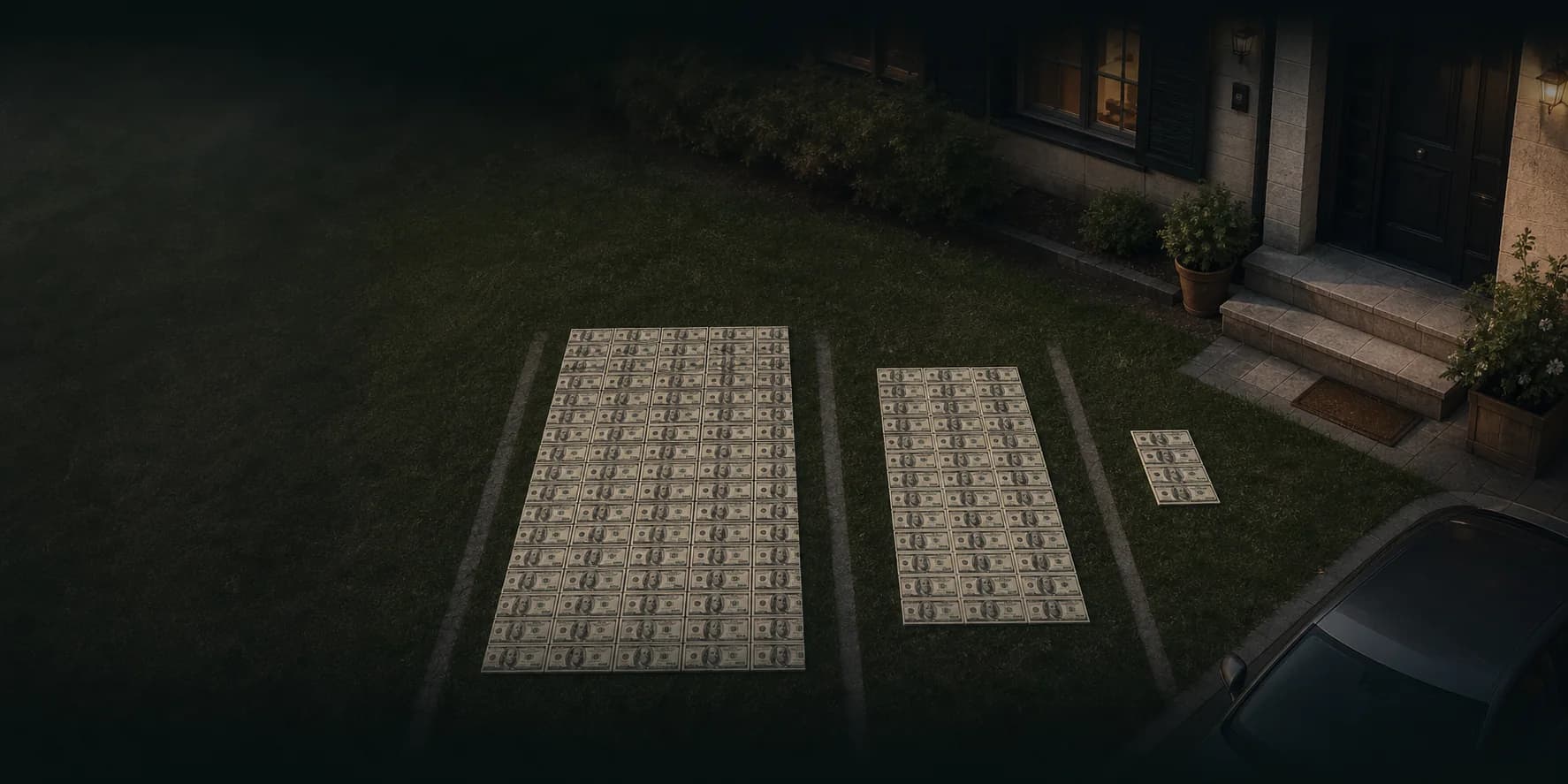
How much space does a year of your salary take up?
Each rectangle shows one year of income laid out in $100 bills. The US example uses 560 notes, the UK example uses 320 and the India example uses 35. Even the largest covers less than six square metres.
United States
$56,000
5.8 m²
560 notes
United Kingdom
$32,000
3.3 m²
320 notes
India
$3,500
3,620 cm²
35 notes

How these numbers were calculated
Divide the dollar amount by 100 to get the number of notes. Area uses the bill's 156 by 66.3 millimetre face. Stack height uses a thickness of 0.1094 millimetres per note, and weight uses one gram per note.
See the paper, printing and security features behind those dimensions in our anatomy of a $100 bill guide, with a numbered list based on the official feature sheet.
Area
156 × 66.3 mm
Notes laid flat with no gaps or overlap.
Stack
0.1094 mm
Thickness per fresh note; used for pile height.
Weight
1.0 gram
BEP figure per note, before circulation wear.
Length
156 mm
Each note laid long edge forward in one line.
Common questions
- How much space does $1 billion take up in $100 bills?
- Laid flat in a single layer, $1 billion in $100 bills covers 103,428 m², about fourteen and a half football pitches. That is 10 million notes. Stacked in one pile instead, the same money reaches 1.1 km, taller than the Burj Khalifa.
- How much does $1 million weigh in $100 bills?
- A US banknote weighs about one gram, so $1 million in $100 bills is 10,000 notes weighing 10.0 kg. Laid flat it covers 103 m², roughly the floor area of an apartment. Their paper volume is about 11.3 litres, so the notes can fit in a gym bag when bundled instead of kept in one tall stack.
- How much does $1 billion weigh in $100 bills?
- $1 billion contains 10 million $100 bills. At about one gram per banknote, the full amount weighs 10.0 tonnes. That is 1,000 times the weight of $1 million in the same denomination.
- How tall is a stack of $1 billion in $100 bills?
- A single stack of $1 billion in $100 bills reaches 1.1 km. The calculation uses 10 million notes at 0.1094 millimetres per note. The resulting stack is taller than the Burj Khalifa.
- What is the difference between a million and a billion dollars?
- A billion is 1,000 million dollars. $1 million in $100 bills weighs 10.0 kg and covers 103 m². $1 billion weighs 10.0 tonnes and covers 103,428 m². Counted at one dollar per second, a million takes 11.6 days and a billion takes 31.7 years.
- How big is $1 trillion in $100 bills?
- $1 trillion in $100 bills laid flat covers 103 km², which is almost exactly the area of Paris inside its ring road and about 1.75 times Manhattan. Laid end to end the same notes stretch 1.56 million km, far enough to reach the Moon and back twice over.
- How long would it take to count to a billion?
- At one number per second without stopping to eat or sleep, counting to one million takes 11.6 days and counting to one billion takes 31.7 years. Counting to one trillion would take 31,688 years, longer than modern humans have farmed.
- How many $100 bills are in a million dollars?
- 10,000 notes. A standard bank strap holds 100 notes, so $1 million in $100 bills is 100 straps. Each strap is about 1.1 cm thick, which is why $10,000 in hundreds is thinner than most smartphones.
- What are the exact dimensions of a US $100 bill?
- Every modern US banknote measures 156.0 by 66.3 millimetres and is 0.1094 millimetres thick, according to the Bureau of Engraving and Printing. Each note weighs approximately one gram. Those four numbers are all the arithmetic on this page is built from.
Sources and calculation notes
- Bureau of Engraving and Printing: banknote dimensions, thickness and weight.
- Federal Reserve: currency in circulation and denomination mix.
- National statistical agencies: land areas for Paris, Manhattan, Rhode Island, Singapore and Greater London.
- RealWorth CPI dataset: purchasing power figures used in the linked calculators. See our methodology.